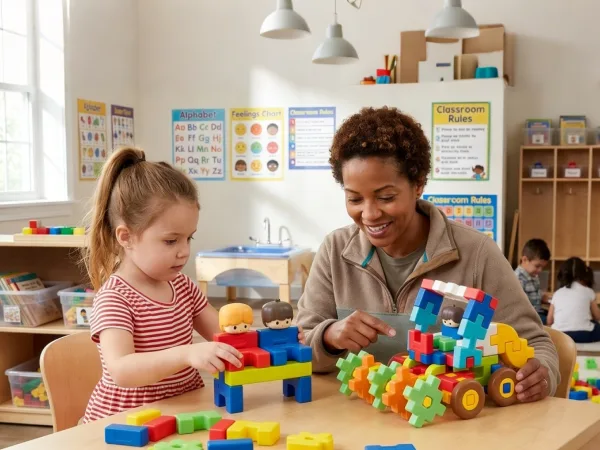
When choosing building blocks for their children, parents typically face three challenges: pieces too small and pose a choking hazard, shapes too simple and quickly lose interest, and one set not enough for two kids who end up fighting over it. Buying two sets doubles the budget; buying one set means daily squabbles—this is the reality for many two-child families.
SUPUZZ's Multi-Dimensional Waffle Interlocking Blocks 122Pcs Set precisely addresses these three pain points. It features a large-piece design, offers far richer shapes than traditional building blocks, and packs everything into one large storage bin—one set is enough for two kids to play together. Below, from an early education perspective, we'll take a detailed look at why this block set is worth adding to your home.
1. Large-Piece Design: Safety Is the First Prerequisite of Early Education
When it comes to early education toys, safety is always the bottom line. SUPUZZ waffle blocks have a minimum single-piece size exceeding 3.5 cm, far larger than the international toy safety standard's definition of "small parts" (under 3 cm). Even babies aged 1–3 who are still in the oral phase cannot fit them in their mouths, so parents can confidently let their children explore independently.
There's another easily overlooked benefit of large pieces: they are extremely friendly to young toddlers whose fine motor skills are not yet fully developed. Children don't need to use their fingertips to precisely grasp; they can use their entire palm to grab, align, and press. The waffle blocks' signature open-grid structure allows fingers to pass through the holes to assist with positioning, making the interlocking success rate far higher than traditional LEGO-style bricks. This "I can do it" positive feedback is crucial for building confidence in children aged 2–4.
2. More Than Just Squares: Cats, Dogs, and Figures Bring Builds to Life
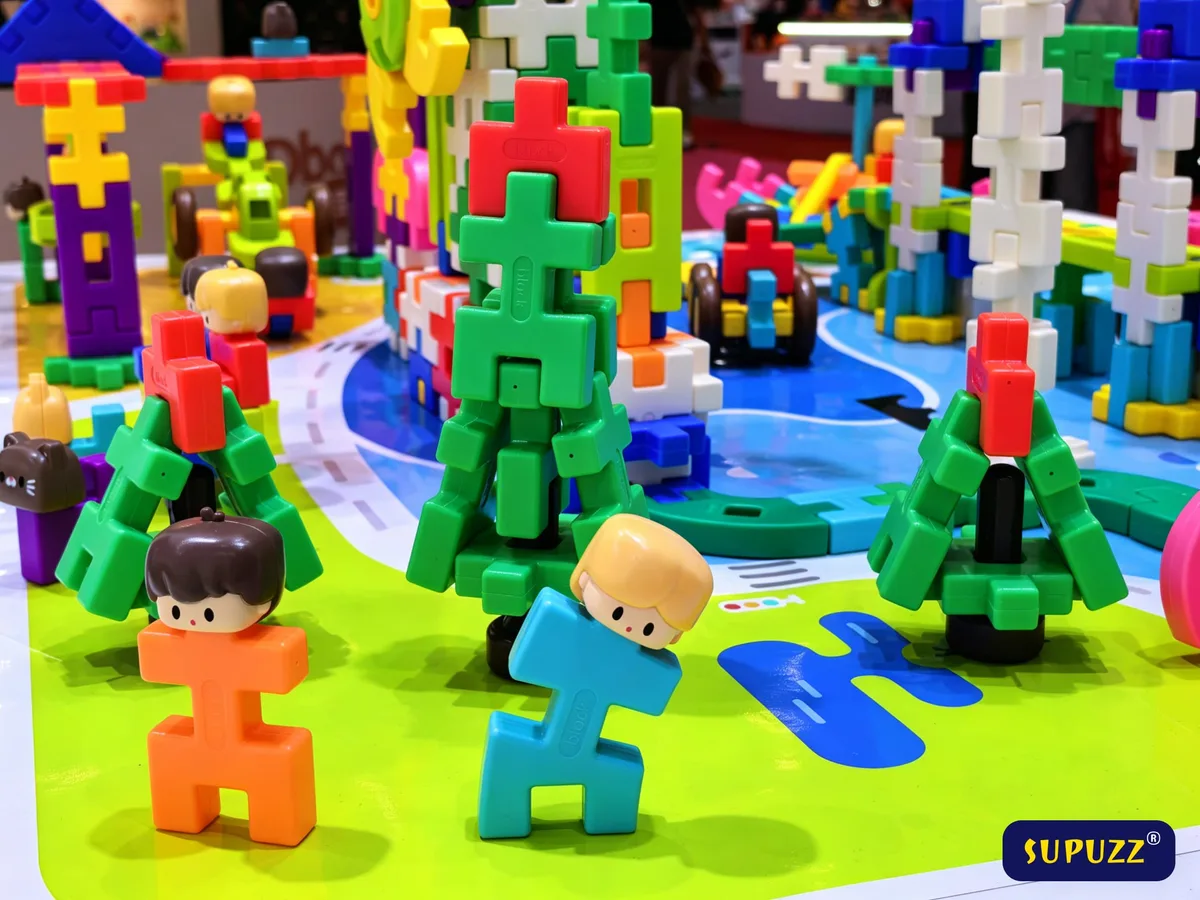
Traditional building blocks are mostly basic geometric shapes—squares, rectangles, triangles. You can build houses and towers, but you can't build scenes that tell a story. SUPUZZ's waffle block series incorporates a wealth of figurative accessories beyond the basic modules:
- Animal characters: Cats, dogs, and bunnies that can be directly inserted into the base or walls, becoming "little visitors" in a playground or "little animals" on a farm.
- Figure pieces: Standable mini-figures that children can use to role-play as mom, dad, gardener, or ticket seller, injecting narrative soul into the building scenes.
- Decorative modules: Flowers, fences, slide panels, roof tiles—not abstract shapes, but "real things" that children recognize at a glance.
What do these figurative pieces mean for children? As psychologist Vygotsky said: young children's cognitive development is inseparable from symbolic play. When a 4-year-old builds a "house" and places a kitten and a person inside, they can start telling stories—the kitten is hungry, the kitten wants to go out, the kitten goes to the playground. Blocks upgrade from "structural construction" to "scene-based storytelling", which promotes language development and social cognition in ways that purely geometric blocks cannot.
A 5-Year-Old's "Kitten Playground" Built with 122Pcs
We observed a real case: a 5-year-old girl used this block set to build an outdoor playground—a spiral slide (assembled from waffle panels), a ticket booth (enclosed by small squares), kitten visitors (animal pieces placed on the pathway), and a "little ice cream seller" figure standing in the booth. The entire process lasted nearly 50 minutes. She progressed from building to role-playing, and from solo play to inviting her younger brother to "visit the playground" together.
3. 122Pcs + Large Storage Bin: The Math Behind One Set for Two Kids
The 122-piece count isn't arbitrary. As a parent of two, you'll quickly realize: too few blocks = conflict. A 50-piece set means one child uses most of them to build a house, leaving the other with nothing to do. The 122-piece volume perfectly lands between "enough to share" and "not wasteful."
Specifically:
- Ample base modules: Approximately 40–50 waffle panels, allowing two children to each build their own base and walls without fighting over core materials.
- Sufficient character pieces: 3–5 animals and figures each, so every child gets their own "characters" and can enter parallel play or cooperative play modes.
- Abundant decorative accessories: Plenty of flowers, fences, and other accessories—even if split in half, neither child's creative expression is affected.
An easily overlooked highlight is the included large storage bin. Many building blocks on the market come in a pile of plastic bags, leaving a mess all over the floor after playtime. SUPUZZ's 122Pcs set thinks ahead for parents right from the packaging—a sturdy plastic storage bin with a snap-on lid, easy to carry away, and easy for children to learn to tidy up themselves. Tidying itself is a form of early education: sorting, putting things back in place, and taking responsibility for one's own belongings.
4. Collaborative Building: From "This Is Mine" to "Let's Build Together"
If you have two kids at home, you've definitely witnessed this scene: one child is building with blocks, the other hovers nearby, then suddenly reaches out and knocks everything down—total collapse, tears erupt. This isn't mischief; it's their way of expressing "I want to join too."
SUPUZZ waffle blocks are naturally suited for collaborative building for three reasons:
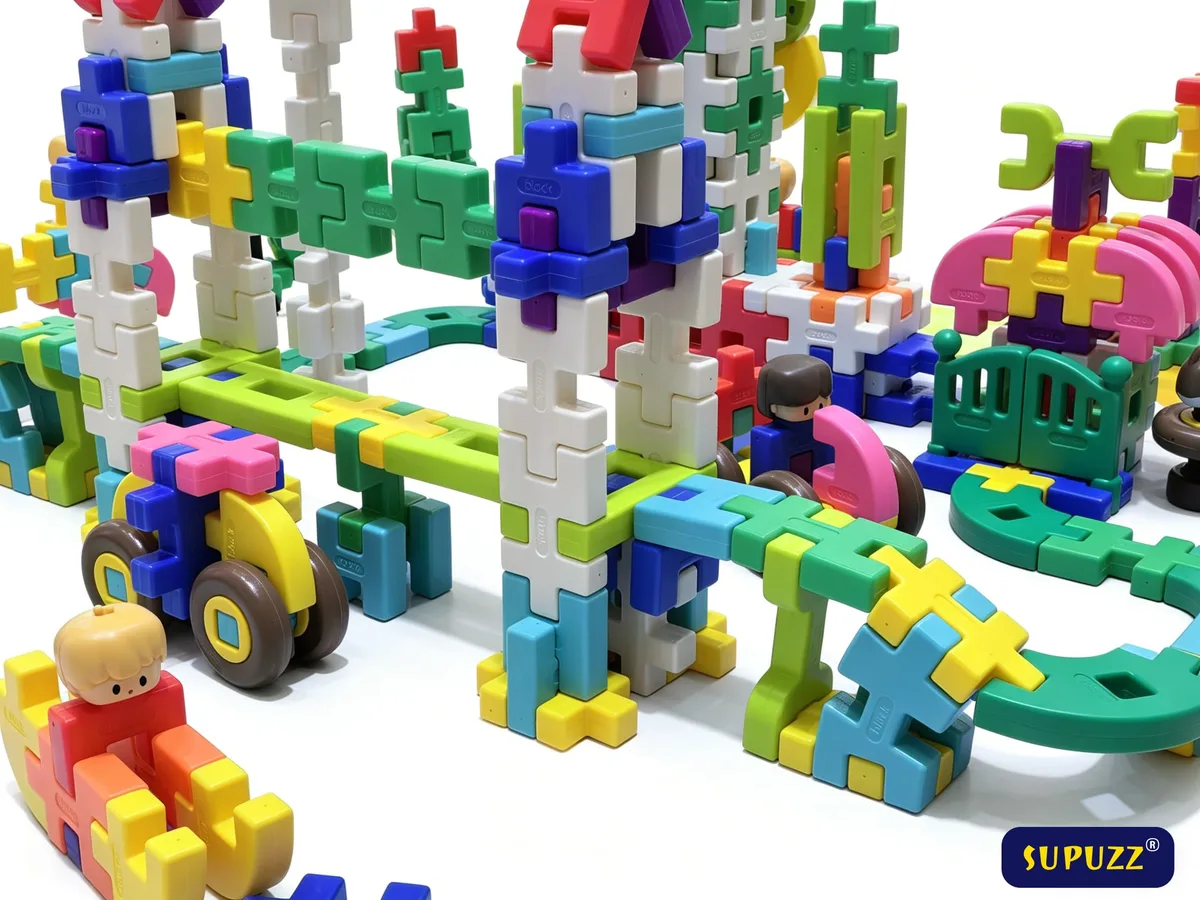
- Waffle panels can be joined infinitely—unlike themed sets that use fixed baseplates, waffle panels support horizontal and vertical expansion in any direction. Two children can build separately first, then connect their "territories" to form one large scene. One builds a playground, the other a farm, connected by fences and pathways—that's the starting point of collaboration.
- Character assignment naturally creates division of labor—one child manages the animals, the other the figures. "Your kitten can come play at my playground"—social interaction happens naturally through play.
- Scene building requires "big project thinking"—building a complete farm and playground isn't something one child can quickly pull off. Collaboration reduces frustration, boosts the sense of achievement, and leads children to help each other: "Why won't this slide connect?" "Here, let me hold the base for you."
Parent Guidance Tip: Start with Division of Labor
If your two children have a significant age gap (e.g., 3 and 6 years old), assign the older child "structural building" tasks (bases, walls) and the younger child "decoration tasks" (placing flowers, animals). This way, both feel they are "contributing," rather than one building while the other causes chaos.
5. Playground and Farm: Two Classic Early Education Building Themes
Playgrounds and farms are the two most familiar settings for children aged 3–6, and they're also where waffle blocks shine brightest as building themes:
Playground Theme
Use waffle panels to build a slide (sloped panel + support columns), a carousel (round base + center axle + animal pieces), a ticket booth (small squares enclosed + figure ticket seller), and fences and pathways connecting each "attraction." Children learn spatial planning and structural stability through building: a slide that's too steep will fall over, a base that's too small won't stand—these are all intuitive physics lessons in the making.
Farm Theme
Use fences to enclose "pastures," waffle panels to build a "barn," place cats, dogs, and bunnies in their respective "pens," and stand a "farmer" figure in the center. This involves classification thinking (different animals in different areas), cause and effect (animals stay put only if the fence is closed), and role awareness (the farmer feeds the animals, milks the cow).
122Pcs Set: One Box, Two Themes, Infinite Possibilities
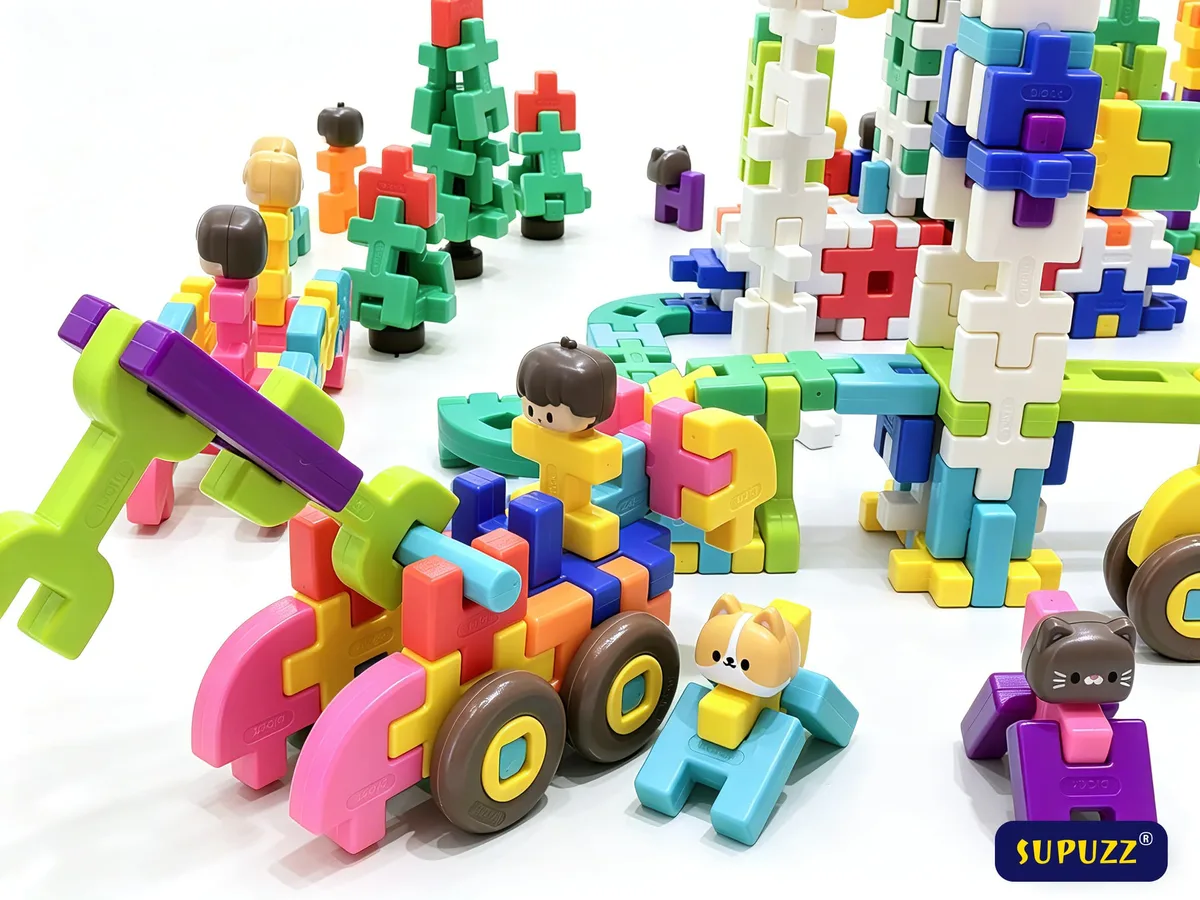
Playground and farm are just two starting points. Children can also build a fire station, zoo, castle, garden, supermarket... The free-interlocking nature of waffle panels means there's no single "correct answer"—every build is a new creation.
6. Skill Development Checklist from an Early Education Perspective
To summarize, here are the core abilities that SUPUZZ multi-dimensional waffle blocks cultivate from an early education standpoint:
- Fine motor skills: Inserting, pulling, aligning, rotating—every interlocking action exercises the small muscle groups in the hands, preparing children for writing.
- Spatial awareness: Flat expansion, three-dimensional enclosure, symmetrical construction—building geometric intuition through play.
- Problem solving: What if the structure collapses? What if the base is too small? How to make the slide taller?—every difficulty is an "engineering challenge."
- Social collaboration: Division of labor, negotiation, waiting, sharing—interaction between two children is more effective than any lecture.
- Language expression: Scene storytelling, character dialogue, describing building ideas—blocks become a "story generator."
- Tidying habits: Cleaning up after play, sorting and putting away—good habits start with the toy box.
Most importantly: children don't perceive any of this as "learning" while playing. They're just building a playground, letting the kitten go down the slide, letting the puppy buy a ticket—and growth is quietly embedded in every interlocking motion.
Conclusion: Why We Recommend the 122Pcs Set
If you're looking for a building block set that will keep your 2–6-year-old engaged for a long time, the SUPUZZ Waffle 122Pcs Set deserves serious consideration:
- Large pieces are safe—1 year+ can explore with adult supervision, and 2 years+ can interlock independently without pressure.
- Figurative pieces like cats, dogs, and figures transform blocks from "abstract construction" into "story-rich scenes."
- 122 pieces are just the right amount to support two children collaborating—no fighting, no separation anxiety.
- Comes with a large storage bin—less hassle for parents, and children learn to organize.
- Two clear theme directions (playground and farm), but the ceiling goes far beyond that.
One block set = an early education toolkit + a social arena for two kids + a tidiness promise that fits back into the box. That's probably the greatest value SUPUZZ multi-dimensional waffle blocks bring to a family.
❓ Frequently Asked Questions
Q: What age is the 122Pcs set suitable for?
Suitable for ages 1.5+ (with adult supervision). Children aged 2–3 can interlock independently with parental guidance, and ages 3–6 can build and create scenes entirely on their own. The large-piece design ensures no risk of swallowing.
Q: How do these blocks differ from regular LEGO bricks?
Three core differences: ① Larger pieces, more toddler-friendly; ② Waffle-style open-grid structure allows fingers to pass through holes to assist with interlocking, yielding a higher success rate; ③ Includes figurative character pieces like cats, dogs, and figures—not just geometric construction.
Q: Is it really enough for two kids? Won't they fight over pieces?
The 122-piece volume is designed with two children in mind. The approximately 50 base panels can be split equally to build separate bases, and each child gets 2–3 character pieces. Plus, waffle panels can be joined together, so two kids can build separately and then connect their creations into one large scene—moving from "building separately" to "building together."
Q: Is the storage bin big enough? Can it hold all 122 pieces?
The storage bin is specifically designed for the 122 pieces. All pieces can be fully disassembled and stored inside with the lid securely closed. We recommend guiding children to put all pieces back into the bin after each play session, building a tidying habit.
Q: Are there building instructions for reference?
The set includes basic building guide illustrations, but we encourage children to freely explore. The joy of waffle blocks lies in their high degree of interlocking freedom—there is no single correct way to build. Parents can start with "Let's build a little house together," then let the child take the lead from there.