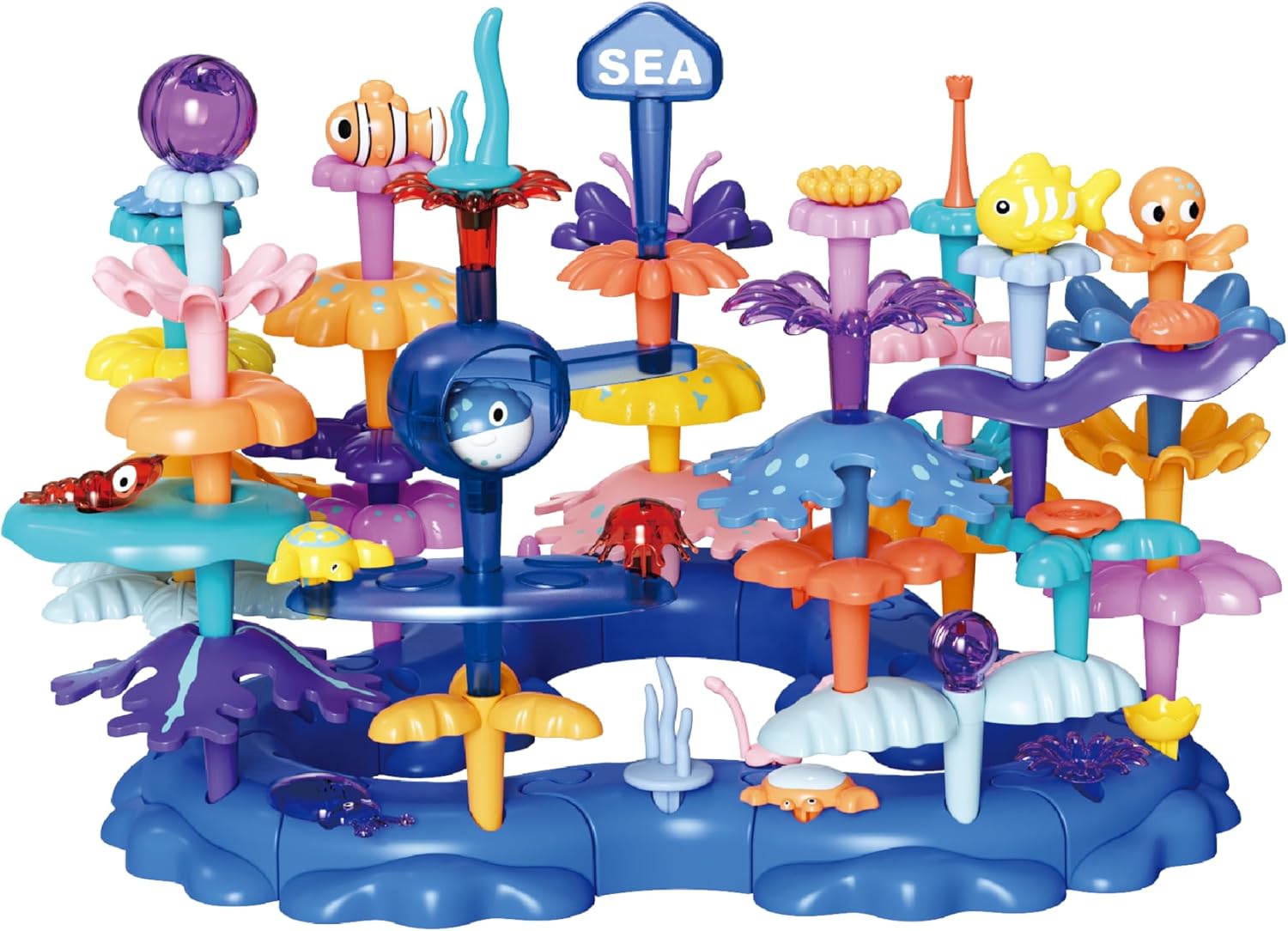
A blue base becomes the ocean floor. A few colorful pieces become a reef. Then your child picks up a sea creature and asks where it should go. That small question is a useful beginning: the building gives the story a setting, and the story gives your child a reason to change the building.
A coral reef building toy can offer a different activity each time it comes out. These five ideas work as short invitations to play. Choose one, follow your child's interest, and leave the others for another day.
Start with space and structure
Set up on a clear, dry floor or table. Put out the base pieces, a small selection of coral forms, and one or two sea creatures. Keep the rest nearby so your child can ask for more. Follow your set's age guidance and assembly instructions; the SUPUZZ Ocean World L2 listing specifies a minimum age of three.
1. Make a route through the reef
Choose one sea creature as the explorer. Invite your child to build a route from one side of the base to the other, leaving gaps between the coral pieces. Move the figure along it together. If it cannot pass a narrow spot, ask which piece could move to make more room.
The route can bend, split, or end at a pretend resting place. There is no need for a perfect layout. Finding a blocked path gives your child a concrete reason to rearrange the scene.
2. Compare a low reef and a taller reef
Use a few pieces to build a low, spreading shape. Then take it apart and try a taller arrangement, using the set's intended connections. Compare what changed: which version leaves more open space, and which uses more pieces in one place?
If an arrangement does not hold together, try a simpler connection or a wider base. Let your child choose the next change. You can describe what you notice without taking over the build.

Add a story and a pattern
3. Tell a lost-and-found ocean story
Pick two figures from your set. One is looking for a friend; the other is waiting somewhere in the reef. Ask your child to choose the hiding place and explain the route there. As the story unfolds, a new coral cluster might become a landmark or a meeting spot.
Keep the pretend story separate from real ocean facts. If your child asks whether coral is a plant, you can explain that corals are animals, as NOAA explains. The toy's bright shapes are an invitation to ask questions and look at real reef photographs together.
4. Build a repeating color trail
Choose two colors available in your set and place pieces in a repeating sequence. Ask your child what might come next, then let them invent a pattern for you to follow. They may prefer to sort the pieces into groups before building.
If you run out of a color, change the rule together. Try alternating shapes, or make two small groups with the same number of pieces. This turns a coral reef STEM toy into a practical prompt for sorting, counting, and comparing during play.
Try asking: “What would you change so our explorer can get through?” A question tied to the child's own reef gives them a clear problem to investigate.
Keep the next build open
5. Take turns changing one thing
Build a small reef together. On each turn, one person may add, move, or remove a single piece. Before changing someone else's part of the scene, ask permission. After a few turns, pause and describe how the reef has changed.
A parent can follow the child's idea rather than directing every step. With siblings, agree on a shared starting point and give each builder a turn to explain their choice. The result might become a winding trail, a busy coral garden, or something nobody planned.

To create your own coral reef, start with the pieces you have and one idea worth trying. Take a photograph before cleanup if your child wants to remember the design. Next time, they can rebuild a favorite part or begin somewhere new.
Explore SUPUZZ Ocean World L2
The Marine Explorer / Ocean World L2 listing describes 76 pieces and seven sea creatures, including a crab, turtle, and pufferfish. Check the selected set's current contents and age guidance before choosing. Our Ocean World L2 product guide offers a closer look at the set.
Explore Ocean World L2 on Amazon